My Top 3 Controversial (and Unethical) Psychology Studies
You may have heard of the Milgram experiment or the Stanford University experiment, but many studies still uncover the dark side of modern psychology as we know it.
Little Albert (1920)
The father of Behaviourism, John Watson, believed that behaviours were primarily learned, and to test his theory, he used a 9-month-old orphan, “Little Albert,” as an experimental subject. He exposed the child to a laboratory rat, which naturally caused no initial fear response. For the next part of the experiment, while the child was exposed to the rat, Watson struck a steel bar with a hammer, scaring the little boy and causing a fear response. By associating the rat with the loud noise, Little Albert’s fear spread to other furry white objects, including a rabbit, a fur coat, and a Santa Claus mask. Naturally, he proved that human emotional responses can be learned through classical conditioning; however, the fear was a condition that needed to be fixed, but the boy left the facility before Watson could remedy things.
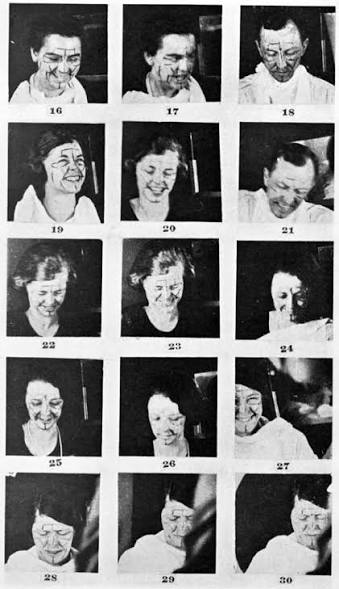
Landis’ Facial Expressions Experiment (1924)
Carney Landis created an experiment on humans to investigate the similarity of different people’s facial expressions. He wanted to determine if people displayed similar or different facial expressions while experiencing common emotions. He exposed them to various stimuli to evoke real emotions, starting with mild triggers like listening to jazz music, smelling ammonia, or looking at pornography.
As Landis grew frustrated with mild reactions, to evoke revulsion he escalated the tasks to extreme and shocking lengths. Participants were forced to put their hands into a bucket of live frogs, experience electric shocks, and most famously behead a live mouse with a knife. If a participant refused to kill the mouse, Landis did it for them. One-third of participants refused to do it, while another two-thirds complied, with a great deal of trauma done to them and the rats. This unethical experiment is one of many reasons review boards were created and have made drastic changes in policy over experiments done on humans.
The Monster Study (1939)
Wendell Johnson, a psychologist at the University of Iowa, conducted an experiment about stuttering on 22 orphans. They divided the 22 children into two groups. Each group was a mixture of children with and without speech problems. One group received praise and positive reinforcement, encouragement, and positive feedback, while the other group was belittled, criticized for any small speech mistake, and repeatedly told they were stutterers, even though many of them spoke entirely normally before the study began.
Children who received mockery naturally made no progress, and some of the orphans with no speech problems developed those very problems. Many of the normally fluent children in the negative feedback group suffered severe psychological harm, became withdrawn and anxious, and developed long-lasting speech problems and low self-esteem. Because the methods were so cruel and mirrored human experimentation seen in Nazi camps, the results were never published in academic journals and were kept quiet for decades.