The Odyssey
For much of his recent career, Christopher Nolan has explored the idea of returning home. In Inception, the journey unfolds through dreams; in Interstellar, the distance between home and its traveller becomes almost unimaginable, stretched across galaxies and distorted by time itself. The Odyssey may therefore be understood as the culmination of this recurring motif: the most literal and physical journey home in Nolan’s filmography, but also its most mythological and morally complex.
Where Inception and Interstellar turn the journey home into an abstraction, Odysseus must cross the physical world itself. His path is marked by islands, storms, monsters, gods, and the vastness of the sea. Yet the voyage remains as psychologically overwhelming as Nolan’s earlier explorations of distance. Every encounter tests not only Odysseus’s ability to survive, but also his understanding of who he is and what he is capable of becoming.
Nolan’s greatest strength may be his ability to execute ideas on an enormous scale. His films are ambitious not only because of their spectacle, but because of the concepts they attempt to transform into cinema. Interstellar turns the mathematics of relativity into a story of love, separation, and survival, even if its scientific ambition occasionally creates emotional coldness. Oppenheimer uses an extraordinary ensemble to turn the creation of the atomic bomb into a moral crisis with consequences extending far beyond the individuals involved.
Both films explore humanity’s approach towards powers once imagined as belonging to gods. In Interstellar, human beings attempt to overcome the limits of time and space; in Oppenheimer, they acquire the power to destroy on a scale previously reserved for divine judgement. The Odyssey brings this fascination into the world of myth. Through intelligence, arrogance, and determination, Odysseus repeatedly enters spaces governed by powers greater than himself. He defies Poseidon, confronts the Cyclops, descends into the realm of the dead, and repeatedly attempts to stand beside, or even challenge, the gods.
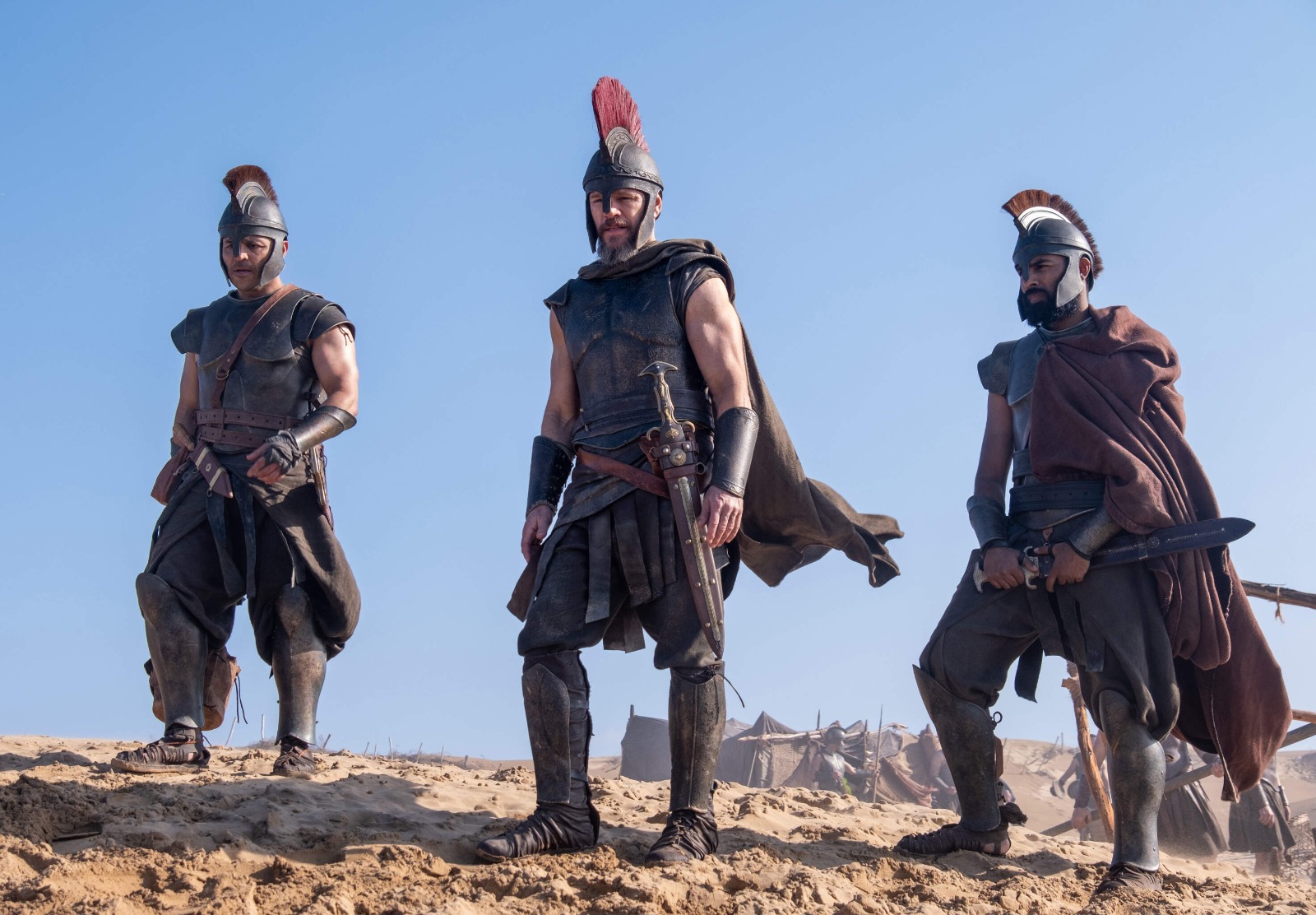
Yet the film is equally concerned with the cost of that ambition. The Trojan horse, which opens the film, establishes Odysseus’s moral burden from the beginning. As he later explains, the horse broke Zeus’s law: it entered Troy as an apparent offering of peace, exploiting the sacred trust between hosts and guests before revealing itself as the instrument of the city’s destruction. The deception is therefore more than a successful military strategy: it violates the moral order that binds civilisation together, making Odysseus’s victory inseparable from betrayal.
During the ravaging of Troy, the decapitation of Athena’s statue becomes visually intertwined with the killing of a young Trojan woman. In Odysseus’s later visions, the woman takes the form of Athena, merging divine judgement with human suffering. The destruction of the goddess’s image and the destruction of human life become inseparable in his memory, turning Athena into an embodiment of the guilt he carries across the sea.
Odysseus is therefore not merely a hero attempting to return to his wife and son, nor simply a mortal punished for his arrogance. He is a man trying to return home after participating in an act that violated the moral order on which the idea of home itself depends. His voyage becomes both a physical journey across the ancient world and a reckoning with the consequences of victory.
Nolan’s use of IMAX amplifies this sense of scale. The expanded image makes the sea, the islands, and the mythological world feel physically overwhelming, while the sound design and Ludwig Göransson’s score give the journey a force that often seems larger than the characters themselves. The format is not simply a technical display; it allows the audience to experience the immense distance separating Odysseus from Ithaca.
Beginning in medias res, the film moves between the aftermath of Troy, Odysseus’s voyage, and Telemachus’s search for his missing father. The story of return is therefore experienced from both directions: Odysseus struggles to reach Ithaca while Telemachus searches for a father who has become almost mythical through his absence. When the two narratives finally converge, their reunion feels like more than the conclusion of a journey. It becomes the restoration of a family divided by war, time, and memory.
The island episodes are compressed, moving quickly and drawing their power from the tension of Odysseus’s encounters with supernatural forces. This occasionally limits their emotional development, but it also gives relentless momentum to the voyage.
The Circe sequence is perhaps the most compelling. Samantha Morton initially presents the character with an apparent vulnerability that conceals her power, before shifting into rage when that control is threatened. The episode also allows Nolan to explore body horror for the first time, as Circe transforms Odysseus’s men into animals and strips them of their human identity. The sequence is inventive and deeply unsettling, although the encounter between Odysseus and Circe feels somewhat rushed. More time could have given their confrontation greater emotional complexity. Nevertheless, its tension remains remarkably effective and contributes to the sense that Odysseus is constantly being forced from one danger into another.
Through these choices, The Odyssey becomes more than a monumental adaptation of Homer. It brings together many of Nolan’s most persistent concerns: the distance between a person and home, the desire to overcome impossible limits, the temptation to approach godlike power, and the moral consequences of doing so. Odysseus crosses the sea in search of Ithaca while carrying the memory of Troy with him, and every encounter becomes another test of whether he can return not only to the place he left behind, but to the person he was before the war.