The Florida Project
Orlando, Florida. Home to Walt Disney World, an amusement park that delights the dreams of children and adults around the world. And, outside its gates, far from the promise of a life of fun, lies the wasteland of the American dream: an entire community made up of low-quality motels, poverty, and wild, happy children.
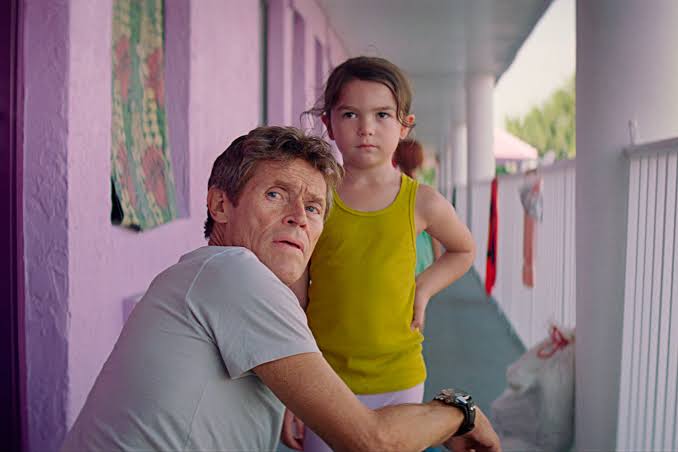
The film follows Moonee, a six-year-old girl who lives with her mother, Halley, at the Magic Castle motel. Moonee and her friends spend the hot summer days getting into trouble, far from the supervision of any adult. Like any child who receives little attention, she lives in a world of freedom and adventure, without thinking about the consequences of her mischief or the problems that hang over her life. To Moonee, this life is not exactly miserable: it is simply her normal childhood. The motel is not merely a symbol of poverty, but the centre of her world: a place of friends, adventure and freedom. It is in this difference between what we see and what Moonee sees that The Florida Project finds one of its greatest strengths.
While Moonee goes through her days unaware of the structures that threaten her world, Halley watches her economic situation deteriorate and the few forms of stability she has gradually disappear, one by one. Like her, other residents of the motel live trapped in a constant state of precarity, supported by unstable jobs and temporary assistance, always one event away from losing what little they still have.
This fragile balance is managed by Bobby, played by Willem Dafoe. Within this little piece of heaven that is the motel, Bobby is the authority, trying at all costs to hold up the walls of a house that could collapse at any moment. He does not merely look after the motel, but its residents as well, repeatedly stepping in to preserve the stability of that small, marginalised community. Yet, no matter how much he protects, reprimands and helps, the sad truth is that he cannot resolve the fundamental precarity of the lives of those who live there. Bobby may be able to stop things from falling apart, but he cannot rebuild what is already doomed to collapse. In a world where the structures around people seem to constantly fail, he represents the possibility of care and empathy still existing between people, even when little more can be done than to extend a hand to the person beside you.
For much of the film, Moonee is able to live entirely within the happiness of her childhood, but that world is inevitably penetrated by the problems that have surrounded her from the beginning. Here, the viewer’s perception is essential: we understand what Moonee still cannot. We see the deterioration of her mother’s life, the fragility of her home, and the future that awaits her. For Moonee, however, none of this exists with the same clarity. Being taken away from that life does not mean being saved from poverty, but being torn away from her mother and the only world she has ever known. It is in this divide between what she feels and what we know that the film finds some of its most painful moments.
The film is particularly effective at highlighting the beauty and joy of life even inside the dark reality in which this motel community lives. The buildings and their surroundings are painted in pastel colours; there is sunlight and rainbows in the air, almost as though everything had come from a dream. And, in the midst of misery, there is laughter and the play of happy children, the empathy of those who work at the motel, the sadness of farewell, and dreams of ice cream and trips to the amusement park, so close yet so far away.
But beauty and joy do not merely exist alongside misery: they exist within it. The Florida Project does not separate poverty from happiness as though they were two distinct realities. Moonee is genuinely happy in that world, even if we know that it is constantly on the verge of collapsing. The Magic Castle, degraded and precarious in our eyes, is, to her, a fairy-tale castle and the centre of her universe.
Sean Baker does not romanticise poverty, nor does he ask us to mistake it for freedom. Moonee’s joy, friendships and imagination do not resolve the circumstances in which she lives, nor do they prevent reality from eventually entering her world. Her happiness is real, but it is also fragile.
And perhaps that is the great irony of The Florida Project: the place where dreams are sold to millions of people as a consumer experience is right there, visible in the distance. But for those who live in the motels surrounding it, the American dream is always something that can be seen, but never truly reached.