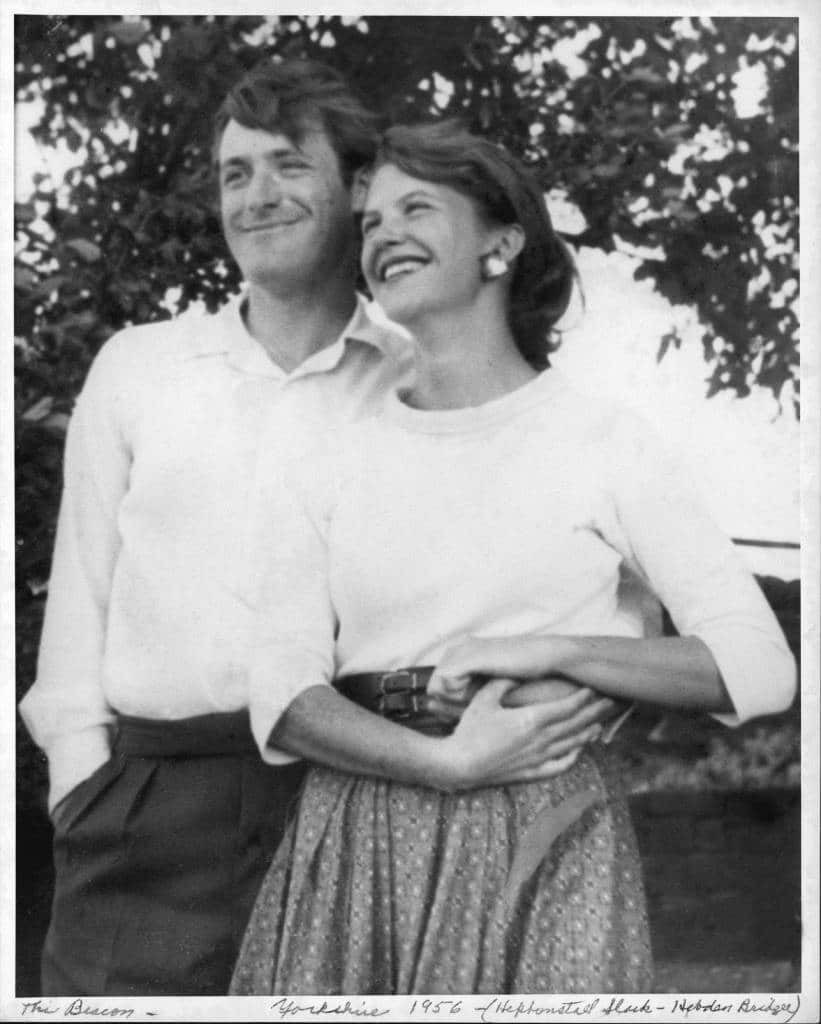
The Literary and Cultural Dialogue Between Sylvia Plath and Ted Hughes
Only few literary figures were able to capture the public imagination as powerfully as Sylvia Plath, whose name is known from The Bell Jar and the fig tree analogy. In contemporary literary culture, Plath occupies a near-mythic status: quoted endlessly online, always invoked when discussing mental health and feminism.
Many of Hughes’s poems were about her. This cultural entanglement is rooted in a marriage that was both creatively generative and personally turbulent. People often say their relationship was deteriorated under the pressures of artistic ambition, emotional volatility, and Hughes’s later infidelity.
When Plath died by suicide in 1963, society cast Hughes into a permanent role within her story. The debate about whether he had killed her indirectly or not was recurrent. It was inevitable that he was labeled as both guardian and interpreter of her work. Public discourse has often mythologized Plath as a feminist martyr and Hughes as the agent of her destruction. Their poetry reveals a more intricate dynamic shaped by shared artistic ambition, psychological fragility, and profound emotional entanglement.
Plath’s work articulates a fierce struggle with identity, trauma, and rebirth , while Hughes’s late poems confront grief, guilt, and the difficulty of narrating a past consumed by myth.
The poems resist any reductive biographical framing: understanding their marriage and its ruptures is necessary, yet an exclusively biographical approach obscures the textual depth and agency present in both writers’ work. Ultimately, the dialogue that emerges across their oeuvres exposes a relationship that was neither purely destructive nor easily categorized, but instead one in which love, hurt, and creativity were inseparably intertwined.
Sylvia Plath and Ted Hughes met in 1956 at Cambridge, beginning a relationship that Plath later described in a BBC interview (1961) as a creative partnership in which “we kept writing poems to each other. . . and having such a fine time doing it, we decided that this should keep on.” They got married in that same year and lived in the United States for two years, where Plath taught at Smith College, before settling in England. Their daughter Frieda was born in 1960, followed by a miscarriage in 1961. That loss was later addressed in poems such as “Parliament Hill Fields.”, published for the first time in The London Magazine in August 1961.
Later on, in 2017, a series of confidential letter from Plath to her psychiatrist, Dr. Ruth Barnhouse (who was the inspiration for Dr. Nolan in The Bell Jar) came to light. According to the Literary Ladies Guide, in those letters, she alleged that her husband at the time, Hughes, was physically and psychologically abusive mainly in the last years of their marriage. And not only that, but Plath also alleged that Hughes assaulted her two days before the miscarriage. Those letters were written by Plath a week before her suicide. When this subject became public, it reignited flames that long engulfed one of the most famed and disastrous literary marriages.
Their son Nicholas was born in 1962, the same year Hughes began an affair with Assia Wevill. Plath and Hughes separated that summer. She died by suicide in February 1963. The biographical tragedy continued to echo across decades: Assia Wevill died by suicide in 1969 and Nicholas Hughes died in 2009. Nicholas’ suicide was something that Hughes had an eye on since Plath’s suicide so he decided to wait until their children were old enough to tell them the details about Plath’s suicide.
Both poets’ careers unfolded under intense public scrutiny after Plath’s death. Hughes became one of the most prominent British poets of his generation, ultimately serving as Poet Laureate from 1984 until his death in 1998. His decision to burn Plath’s final journal and to control the publication of her work, most notably Ariel, remains a point of critical contention. Plath’s literary reputation, meanwhile, grew rapidly after her death. Although The Colossus (1960) and The Bell Jar (1963) received modest attention during her lifetime, the posthumous publication of Ariel established her as a central figure of confessional poetry and a major influence on feminist literary movements. Her struggles with depression, electroconvulsive therapy and repeated suicide attempts form part of the historical context of her writing but do not define its complexity; her late poems, including “Lady Lazarus”, “Cut” and “Daddy” reveal a refined control of persona, metaphor, and mythic structure that transcends the purely autobiographical, Rose, pp. 45–49.
Understanding the pressures of Plath and Hughes’s marriage, along with the psychological and professional demands they each faced, provides crucial context for interpreting the poetic dialogue that emerges between Ariel and Hughes’s Birthday Letters while avoiding reductive moral narratives and maintaining a focus on their literary achievement rather than personal scandal.
When it came to her posthumous editing, Hughes was the one with most control. Although they were separated when the suicide happened, they were not formally divorced yet. In 1965, Hughes released Ariel, a collection of poems where Plath expressed her ongoing battle with depression and her relationship. Hughes was accused of editing some verses in an attempt to preserve his reputation and he had also omitted twelve poems that Plath had specifically marked to be a part of Ariel (Encyclopaedia Britannica). So, in 2004, a restored edition was disclosed and, this time, there weren’t any modifications to her work. Much can be discussed regarding the role Hughes played in Plath’s life and death. However, the most important notion to be aware of, is that Hughes used his power and influence to mark the way we see Plath’s work and how he was able to create a misperception of Plath onto others (Brampton College).
Throughout the years, Hughes has been blamed for Plath’s death. Feminist scholars (as seen in Literary Hub), have always interpreted Plath and Hughes’ relationship as the dichotomy between patriarchal oppression and destructive male figure, as seen in “Daddy”. That narrative didn’t even stop with Plath’s death, Birthday Letters was an attempt to try to gain that power back. In the most recent feminist critiques, there’s a new tendency to reject the simplistic victim-villain narrative.
Nowadays, feminism papers show how the most recent examination of their marriage is seen as emotional and artistically reciprocal, rather than unidirectional. There’s a new interpretation about Plath: instead of being seen as a passive suffered , she’s now seen as a highly self-aware artist.
The biography presented serves solely as a context. The primary focus in this writing sample regards the intertextual dialogue and poetic structure and imagery.
When doing a close reading for the poems published in Ariel there’s a clear pattern about how Plath’s mind worked as a poet. In the poem “Daddy”, there’s a recurrent description of her father as “a bag full of god”. When describing her father, in all of her poems, she sees him as a mythical, religious figure. Through metaphors and descriptions of her father as a god-like figure, we can feel her pain about her father’s death. It seemed like one of the only ways she could use to cope with his death was to put him on a pedestal, like someone who was out of reach and bigger than her. Hughes responded by reflecting on Plath’s tendency to elevate her father to a divine figure, suggesting that she extended this pattern to all significant men in her life, himself included.
In “Lady Lazarus” the speaker presents herself as a figure who repeatedly confronts death and returns, a pattern that unmistakably echoes Plath’s well-documented suicide attempts. Hughes, in a 1995 Paris Review interview (Sylvia Plath Forum), analyzed Sylvia Plath’s “resurrections” and the function of her poetry. Yet, unlike the resurrections of the biblical Lazarus, Sylvia Plath’s resurrections are self-inflicted, emerging from cycles of psychological collapse and recovery. The poem operates as a form of catharsis, transforming private anguish into public performance. In the interview, Hughes emphasizes how dangerous this cycle was, suggesting that because she didn’t knew what The Bell Jar and the Ariel poems were going to do to her life,” the intensity of the “ritual” ultimately consumed her.
During “Lady Lazarus”, Plath describes her past suicide attempts, highlighting the pain she was feeling at the time.
Plath frames her own attempts as performative, a critique of the voyeuristic public and the moralizing gaze that seeks to control female expression. It also reveals how the public reacts to personal pain with morbid curiosity, insensitivity and judgement rather than compassion. At the time, everyone knew about Plath’s depression, therefore it seems like this poem is used as a way to help the public understand that her suicide attempts were not provoked by herself per se but caused by her emotional intensity. . In this sense, Plath reframes suicidal behavior as an expression of overwhelming affect rather than an indulgent or attention-seeking gesture, countering the moralizing commentary that frequently surrounded her in life.
This dynamic takes on additional complexity when read alongside Ted Hughes’s “Red”, a poem that revisits Plath through the retrospective lens of Birthday Letters. In Lady Lazarus, Plath, the color red is used not only as a symbol of passive suffering but also as a symbol of active, aggressive rage that reclaims power from those who oppressed her. When Plath wrote: “I rise with my red hair / And I eat men like air” (last two verses of the poem), it’s clear that red is used as a statement of empowerment, rage and violent resurrection. While in Birthday Letters, Hughes wrote “If not red, then white. But red / Was what you wrapped around you. / Blood-red. Was it blood?” (verses 2-4). In those verses, the color red symbolizes the wound saturated with emotional pain that ultimately consumed her and instead of using the color red as a symbol of rebirth like Plath uses, Hughes used it to represent an injury (this poem will be analyzed in the next page). For instance, when the speaker describes her second suicide attempt, the imagery evokes the peacefulness of the sea, alluding to the rhythmic, calming waves of the ocean. Her suffering is so big, that she sees death as a pill to end the pain.
Plath uses imagery and rhythm in her poems to give the reader a more emotive reading.
She used to use poetry as therapy and a way to cope with her depression. Poetry saved her for a long time until it wasn’t enough. Plath writes from within the storm, transforming trauma into empowerment, while Hughes writes from its aftermath, interpreting red as the residue of loss.
The way Ted Hughes coped with that was writing Birthday Letters. The collection of poems was published in 1998 (six years after her death). Even though the collection received a lot of criticism, it also was a commercial success. It won the T. S. Eliot Prize and the Forward Poetry Prize for Best Collection due to the emotional depth and vivid imagery. This led to a renewed interest in Plath’s work and their relationship, which led into new biographies and critical studies.
Just like Plath, Hughes uses imagery (of animals, landscapes and weather) to add depth and complexity to his poetry. There are three more prominent themes in his poetry (there are, obviously, more themes, nonetheless these are the ones which are going to be more described): power and control, role of the women and passage of time. The power and control concept are directly connected to the passage of time. “Fullbright Scholar” is the perfect example of that. During the poem, Hughes reflects on his own memories with Plath and realizes how the power dynamics can shift over time. He examinates those shifts of power through elements of the unconscious such as dreams and symbols. Plath was a major feminism icon and her poetry often addresses issues related to gender inequality.
“The shot” is a poem where Hughes addresses his former wife directly and he describes how Plath needed to have godlike figures to love, so she created them herself. He even describes the conclusion he reached when he realized that: with her father’s death, she started to create these godlike figures to help her cope. This poem explores love, obsession, family trauma, fate. . . Ariel and Birthday Letters are clearly intertwined, as discussed in Her Husbands: Ted Hughs & Sylvia Plath. Plath, of course, could not have anticipated the degree to which Hughes would later write a book to help him cope with the sadness he felt at the time.
Anyhow, in all this collection of poems, the message is clear: Hughes wanted the public to know that Plath didn’t know how to love lightly: she had to put men on a pedestal like they were a religious devotion. Indirectly, Ted Hughes tries to show us how that was killing her slowly. He also uses the word “daddy” frequently in all poems in an allusion to Plath’s famous poem “Daddy” in which she addresses the loss of her father, Otto, and compares her father to a mythical god. From Hughes point of view , she builds these men up allowing them to take over her mind and life and, in the end, love was one of the things that destroyed her.
As previously noted, Hughes’s poem “Red” occupies a crucial position in any comparative discussion of Plath’s and Hughes’s poetic voices. In this poem, he employs colour symbolism to convey both Plath’s psychological states and the dynamics of their intimate relationship. Red symbolizes immortality, death and anger while white symbolizes purity and order. Blue, in contrast, represents hope and freedom, concepts that Hughes sees as a lost ideal for her. Plath frequently invests color and imagery with broader, more universal resonances, enabling her symbols to operate independently of autobiographical constraints. This divergence underscores the contrasting epistemologies through which the two poets engage with lived experience: Plath’s poetic imagination transforms personal and cultural trauma into emblematic, universally resonant forms, whereas Hughes’s imagery reflects a mediating, interpretive perspective, one oriented toward memory, accountability, and emotional mediation.
Similarly, “The rabbit catcher” describes an unsettling imagery where violence and oppression are prominent. The poem creates a sense of being trapped through physical imagery such as wind “gagging” the speaker and the sea “building” her. It also represents the destructive force of the relationship. Later, Hughes also wrote a poem named “The rabbit catcher”, in which he addresses Plath’s poem. The juxtaposition of these paired works illuminates the fundamentally divergent interpretive positions of the two poets: The wife and husband could never agree on something. They offer different opinions and insights even about the smallest things. We can see that in poems like “Fullbright scholar” where Hughes offers to the public a completely different version of how they met.
At the time, he was hurting and that’s clear in “Life after death”: her ghost still remains with him like in their son’s eyes. Hughes felt the need to write all of these poems to come to terms with his own guilt and grief.
Their literary and personal relationship is very significant to literary studies. It shows how biography and poetry have this marvelous possibility to interact. At the time of publication (1998), criticism in newspapers mentioned that the whole point of Birthday Letters was to reflect on her life, death and loss and what Hughes was able to feel about these as he grew a progressively older and perhaps couldn’t feel or understand so clearly at the time. This refers to the duality of the voice in Birthday Letters, the experiencing self: the young and confused Hughes in the poems who did not understand what was happening versus the narrating self: the older and retrospective Hughes writing. This just goes to show how deeply painful they are and how the relationship between them was so much more complex than any of us realize. In their case, poetry served as a “dialogue between the living and the dead”. It also represents how the truth may look different for each person. There is no single correct version. The reader must consider both sides of the story. These poems cannot be read without knowing the full story behind them, or their complexity is flattened.
Ariel and Birthday Letters engage in mutual, posthumous conversations, transforming personal experience into artistic expression. Plath’s work focuses on patriarchal structures and the limits of personal agency, while Hughes’s poetry focuses on grief, guilt and authority. His poems came in response to his trauma and his real thoughts about Plath (even if it’s through myth-making and not through a literal confession).
The interplay of imagery, myth, and intertextuality underscores how personal experience can be transformed into literary dialogue, producing enduring artistic significance. Hughes’s responses, while controversial, illuminate the ethical and emotional stakes of literary inheritance, reminding readers that the act of writing is both deeply personal and culturally resonant.
In the end, the Plath-Hughes dialogue complicates notions of victimhood, genius, and blame. It demonstrates the power of poetry to mediate trauma, preserve memory, and shape public perception, offering an enduring study of how personal relationships can inform, challenge, and expand literary creation.