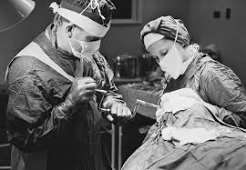
The Disturbing Procedure of Lobotomy
In 1949, Egas Moniz was awarded the Nobel Prize for a “miracle cure” intended to treat severe mental illnesses like depression and bipolar disorder. This “cure” involved severing connections in the brain’s prefrontal cortex. Surgeons would drill a pair of holes into the patient’s skull and sweep a sharp instrument from side to side, blindly cutting the pathways between the frontal lobes and the rest of the brain.
Moniz reported improvements in his early patients, which caught the attention of American neurologist Walter Freeman. Freeman took the procedure and transformed it into a mass, worldwide phenomenon. His most infamous and chilling innovation was the transorbital lobotomy. Bypassing the need to drill into the skull, Freeman used an ice pick driven through the patient’s eye socket. This allowed him to perform the surgery in mere minutes, often in an outpatient setting and without general anesthesia. Because of this terrifying efficiency, lobotomy numbers skyrocketed; from the 1930s to the 1970s, approximately 40,000 to 50,000 lobotomies were performed in the United States alone.
The widespread acceptance of this procedure was driven by a desperate reality: the alternative was often viewed as worse. The slim chance of a “cure” through a lobotomy seemed preferable to a life sentence in an institution. However, the procedure was quickly weaponized as a tool for social control rather than genuine psychiatric care. Women were disproportionately targeted, making up roughly 60% to 74% of all patients in the 1940s and 1950s, despite men having higher rates of diagnoses like schizophrenia. Critics later exposed that the surgery was frequently forced upon rebellious individuals, non-conforming women, and institutionalized patients without true consent.
The aftermath was rarely miraculous. While some patients exhibited reduced anxiety or aggression, the cost was staggering. Many suffered severe, permanent brain damage resulting in a total loss of emotional depth, reduced initiative, and childlike behavior. The procedure irreversibly wiped away a person’s personality and cognitive independence.
One of the most tragic and famous examples of the life-threatening effects of lobotomy is Rosemary Kennedy (sister of John F. Kennedy). In an effort to “cure” her rebellious behavior and prevent potential scandal, her father arranged for a lobotomy. The operation was a catastrophic failure. It left Rosemary with the capabilities of a two-year-old, and she was permanently incapacitated and unable to walk or speak intelligibly.
The downfall of the lobotomy finally began in the 1950s with the development of Chlorpromazine (Thorazine), the first antipsychotic drug, which offered a real pharmacological alternative to brain mutilation. While the Soviet Union banned the barbaric practice on moral grounds in 1950, mainstream Western medical communities widely abandoned it by the late 1950s, replacing crude cuts with precise modern medications.
Ultimately, the lobotomy transitioned from a celebrated medical breakthrough into one of psychiatry’s darkest chapters. Today, its legacy survives primarily in pop culture and internet slang. Terms like “lobotomy face” or “needing a lobotomy” are used hyperbolically to describe mental exhaustion, the brain rot of doomscrolling, or a desire for mindless compliance. A niche online aesthetic even blends Tumblr melancholy with irony, glamorizing a detached, emotionally numb persona reminiscent of “heroin chic.” There is a dark irony in this modern usage: a younger generation, overwhelmed by the complexities of the digital age, now playfully craves the very emptiness that was once brutally forced upon tens of thousands of victims.